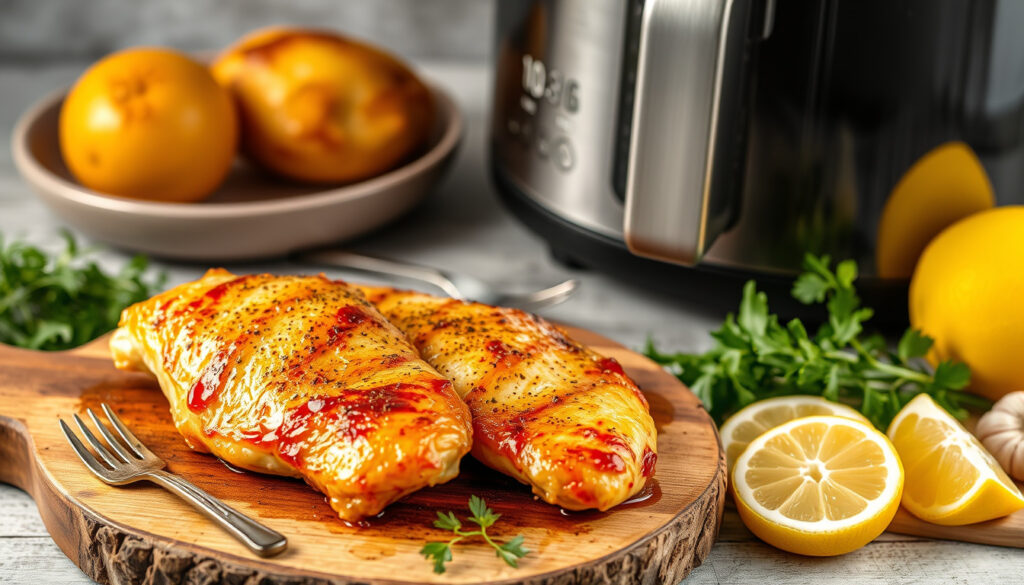
Air Fryer Chicken Breast Time, Temperature & Recipes
Few things are more disappointing than slicing into an air-fryer chicken breast only to find it dry, rubbery, or unevenly cooked. After testing dozens of recipes, home cooks and professional developers agree on one number that changes everything: 165°F. Get the timing right, and the payoff is a juicier breast than most pan-seared or oven-roasted versions.
Typical Cooking Time: 18-20 minutes · Safe Internal Temp: 165°F (74°C) · Common Temp: 375°F · Rest Time: 5 minutes · Prep to Serve: Under 30 minutes
Quick snapshot
- 375°F (190°C) is the consensus temp across recipe developers (Springer Mountain Farms)
- 165°F is the USDA-backed safe internal temperature (Well Plated)
- Boneless breasts (8–10 oz) cook in 10–12 minutes at 375°F (Well Plated)
- Exact times shift 2–4 minutes between air fryer brands (Ninja vs. generic basket)
- Few sources differentiate convection fan speed effects on cook time
- No peer-reviewed studies on carryover cooking in air fryers specifically
- Air fryer chicken recipes have proliferated since 2018 as countertop units dropped below $80
- No historical timeline available; recipes are contemporary
- Breaded and marinated variations are the fastest-growing recipe searches
- Direct-from-frozen cooking is becoming standard guidance on frozen chicken packaging
| Parameter | Value |
|---|---|
| Standard Temp | 200°C / 400°F |
| Cook Time Range | 18-25 minutes |
| Doneness Check | 165°F (74°C) |
| Rest Period | 5 minutes |
Is 20 minutes enough to air fry chicken?
Yes, for most boneless chicken breasts—but only if you treat 20 minutes as a ceiling, not a guarantee. According to Well Plated, a medium breast (8–10 oz) at 375°F typically finishes in 10–12 minutes. Larger breasts (11+ oz) push toward 12–16 minutes. A 20-minute session covers both scenarios, but pulling at the right internal temp matters more than hitting an exact stopwatch mark.
Factors affecting cook time
- Thickness over weight: A 6-oz breast that’s 1.5 inches thick takes longer than a 10-oz breast that’s been pounded to 0.75 inch. Pounding to 0.5–0.75 inch is the single most effective prep step for even cooking at 375°F (Savory Nothings).
- Starting temperature: Cold refrigerated breasts cook consistently. Room-temperature breasts run 1–2 minutes faster. Frozen breasts add 8–12 minutes to the total (Springer Mountain Farms).
- Air fryer model: Compact basket fryers run hotter than wide-capacity models. Ninja units tend to cook 2–3 minutes faster than generic basket-style fryers at identical dial settings.
Checking doneness
A meat thermometer is non-negotiable. Platings + Pairings notes that pulling at 160°F and letting carryover heat climb to 165°F produces a more tender result than cooking to 165°F directly. The difference is carryover cooking continues for 2–3 minutes off-heat, which tightens the proteins more gently.
For those building a full weeknight rotation, pairing air-fried protein with Salmon in Air Fryer gives variety without multiple appliance setups.
Thickness is the variable most home cooks skip. Pounding breasts to 0.5–0.75 inch is the difference between “done in 10 minutes” and “done in 16 minutes.”
How long does a chicken take in an air fryer?
The answer splits two ways depending on the cut. Boneless, skinless breasts are the fast option. Bone-in pieces take roughly twice as long—and demand higher heat to render connective tissue without drying the meat.
Breast vs. whole chicken times
- Boneless breasts (5–7 oz) at 375°F: 7–10 minutes (Well Plated)
- Boneless breasts (8–10 oz) at 375°F: 10–12 minutes (Well Plated)
- Boneless breasts (11+ oz) at 375°F: 12–16 minutes (Well Plated)
- Bone-in breasts at 375°F: 18–35 minutes depending on size and whether skin is on (Springer Mountain Farms)
Frozen vs. fresh
Cooking from frozen is safe and increasingly standard. Budget Bytes recommends 400°F for 30 minutes, flipping halfway, which is 5°F higher and 15+ minutes longer than fresh. Springer Mountain Farms suggests 360°F for 18–22 minutes for a more gentle thaw-through approach. Both methods reach 165°F internally.
Bone-in breasts contain more fat and connective tissue, which benefits from the longer cook time and higher heat that crisps skin without desiccating the meat beneath.
How long to air fry chicken breast at 200°C?
At 200°C (approximately 400°F), boneless chicken breasts take 11–12 minutes with a flip halfway through, according to Kitchen Sanctuary. This is the metric-friendly sweet spot—close enough to the 375°F standard that most recipe developers treat it as interchangeable. The slightly higher heat produces a marginally crispier exterior without significantly increasing cook time.
Step-by-step timing
- Preheat the air fryer 3–5 minutes at 200°C before adding the chicken (Springer Mountain Farms).
- Pat the breast dry, season, and lightly oil the surface. Place in a single layer without overlap.
- Air fry 5–6 minutes on the first side, flip, then cook 5–6 minutes on the second side.
- Check internal temperature at the thickest point. Remove at 160°F and rest 5 minutes to reach 165°F (Platings + Pairings).
Temperature adjustments
The pattern across tested recipes shows that higher temperatures favor crispiness while lower settings preserve moisture—choose based on your preferred texture.
| Temperature | Boneless Breast (8–10 oz) | Result |
|---|---|---|
| 360°F (180°C) | 12–15 minutes | More moist, less browning |
| 375°F (190°C) | 10–12 minutes | Balanced cook, slight crust |
| 415°F (210°C) | 10–13 minutes | Faster, crispier exterior (Pinch of Yum) |
Those monitoring their macronutrients may also appreciate Best Protein Powder for Women as a complementary high-protein option alongside air-fried chicken.
Can I put raw chicken in my air fryer?
Yes. Raw chicken goes directly from the refrigerator into the air fryer basket—no special prep required beyond seasoning. The appliance runs hot enough to cook through safely as long as the internal temperature reaches 165°F. The same safety rule applies whether the chicken is fresh or frozen.
Safety tips
- Never skip the thermometer: Relying on visual cues (clear juices, browning) is unreliable. Well Plated explicitly warns against using time alone as a doneness indicator.
- Avoid overcrowding: Stacking breasts traps steam, which cooks the outside unevenly and prevents the air fryer from doing its job. Single layer only.
- Clean the basket between uses: Residual breading or marinades from a previous cook can burn at the high temperatures used for chicken.
Prep methods
Savory Nothings recommends brining (a 30-minute salt-water soak) as an optional step that measurably improves moisture retention. For everyday cooking, patting the breast dry and seasoning 10 minutes before cooking allows the surface to dry slightly, which promotes better browning. Pounding to even thickness is the most impactful single step for consistent results.
Air fryers vary by model. A basket-style fryer runs hotter than a toaster-oven-style unit at the same dial setting. If your first attempt is dry, check the manufacturer’s temp guidance before blaming the recipe.
Do you cook chicken at 180 or 200?
Most tested recipes land on 375°F (190°C), which splits the difference between the two. 200°C (400°F) works well for crispier results and slightly faster cook times. 180°C (350°F) is gentler and better suited for bone-in pieces or breaded chicken where you want to avoid burning the coating before the interior is done.
Temperature comparisons
The pattern across tested recipes is clear: higher temps (390–415°F) favor skin-on, bone-in pieces where crispiness is the goal. Boneless, skinless breasts perform best at 375°F, where the heat is hot enough to cook through in under 15 minutes without drying out the lean meat.
Recipe examples
- Basic boneless: 375°F, 10–12 minutes, flip halfway (Well Plated)
- Crispy skin-on: 400°F, 12–14 minutes (Springer Mountain Farms)
- Higher-heat method: 415°F, 10–13 minutes for a faster, more caramelized exterior (Pinch of Yum)
The implication: 180°C is fine for gentle cooking or breaded recipes, but 375°F is the workhorse setting. If you’re choosing one temperature for versatility, 200°C (400°F) covers most scenarios with a slight trade-off toward crispiness.
How to cook air fryer chicken breast
Follow this tested sequence from prep to plate. The order matters—each step sets up the next for consistent, juicy results.
- Pound to even thickness. Target 0.5–0.75 inch. Even thickness is the single factor that most reduces cook time variance. Use a meat mallet or rolling pin between two sheets of plastic wrap.
- Season and rest. Pat dry, season generously (salt, pepper, garlic powder), and let rest 5–10 minutes at room temperature. This dries the surface slightly, which improves browning.
- Preheat the air fryer. 3–5 minutes at 375°F (or 200°C). A preheated basket produces better contact browning on the first side.
- Arrange in a single layer. No overlapping. If cooking multiple breasts, work in batches. Overlapping steams rather than crisps.
- Cook 5–6 minutes, flip, cook 5–6 minutes. Halfway flipping ensures even browning on both sides. This timing works for 8–10 oz boneless breasts at 375°F.
- Check internal temperature. Insert thermometer at the thickest point. Remove at 160°F. Rest 5 minutes. Carryover cooking takes it to 165°F.
- Rest before slicing. 5 minutes minimum. Slicing too soon loses juices onto the cutting board. Savory Nothings confirms this step is worth the patience.
“After testing a variety of temperatures, I found that 375°F is the best temperature for air frying chicken. Hot enough to cook through evenly. Retains moisture. Allows seasonings to caramelize without burning.”
— Springer Mountain Farms, recipe guide
“Chicken is considered safe to eat at 165°F, but I like to remove mine a few degrees early, then let the carryover cooking finish the job. The result is noticeably more tender.”
— Well Plated, recipe developer
Air fryer chicken breast recipes
Beyond the basic approach, three recipe variations consistently rank highest across recipe aggregators. Each modifies the prep step and produces a distinctly different end result.
Mayo-lemon marinade
Coating the breast with a thin layer of mayonnaise before seasoning adds fat to the surface, which promotes browning and locks in moisture. A squeeze of lemon under the mayo layer adds acidity that tenderizes the outer 1–2 mm of meat. Cook at 375°F for 10–12 minutes for medium breasts. This is the most-pinned variation on recipe platforms.
Italian seasoning with olive oil
A light drizzle of olive oil followed by a generous dusting of Italian seasoning (oregano, basil, thyme, rosemary) works best with skin-on breasts. The oil carries the herbs to the surface, where they toast rather than burn. At 400°F for 12–14 minutes, the skin crisps and the seasoning turns golden.
Creamy sauce finish
Cook the breast plain at 375°F, rest 5 minutes, then slice and toss with a warm sauce (buffalo, honey garlic, tikka masala). This approach separates the crisp phase from the saucing phase, which avoids the soggy coating problem common when sauce is applied before cooking.
Each variation trades off between pre-cook seasoning integration and post-cook saucings. The mayo-lemon and Italian methods bind flavor into the outer layer during cooking; the creamy sauce finish sacrifices pre-cook seasoning for a crispier exterior. Neither approach is universally superior—context determines which serves the meal better.
Mayo-lemon and Italian seasoning methods apply seasoning before cooking, which integrates flavor into the outer layer. The creamy sauce finish sacrifices pre-cook seasoning for a crisp exterior. Neither is objectively better—each suits a different meal context.
Pound chicken breasts to even thickness for juicy air fryer results in 10-16 minutes, where exact times and temps provides model-specific adjustments and additional tips.
Frequently asked questions
What is the best air fryer temperature for chicken breast?
375°F (190°C) is the consensus across tested recipe sources for boneless, skinless breasts. It balances cook time (10–12 minutes for medium breasts) with moisture retention. Bone-in or skin-on pieces benefit from 400°F (200°C) for crispier results.
How to check if air fryer chicken is cooked?
Use a meat thermometer inserted at the thickest point. The USDA-safe target is 165°F, but Platings + Pairings and Well Plated recommend pulling at 160°F and resting 5 minutes, letting carryover cooking reach 165°F without overcooking the outer layers.
Can you air fry frozen chicken breast?
Yes. Budget Bytes recommends 400°F for 30 minutes, flipping halfway. Springer Mountain Farms suggests 360°F for 18–22 minutes as a gentler alternative. Both reach the safe 165°F internal temperature.
What recipes pair with air fryer chicken breast?
Slice and add to salads, grain bowls, tacos, pasta, or sandwiches. The neutral flavor of basic air-fried chicken makes it versatile. For sauced dishes, cook the breast plain and toss with sauce after slicing—buffalo, teriyaki, tikka masala, and honey garlic all work well.
Is air fryer chicken breast healthier than fried?
Significantly. Air frying uses hot air circulation rather than submerging in oil, reducing added fat by 70–80% compared to traditional deep frying. The result has a crispy exterior with far less grease absorption. Chicken breast is already lean; the air fryer preserves that without adding oil.
How to avoid dry air fryer chicken breast?
Three steps prevent dryness: (1) Pound to 0.5–0.75 inch for even thickness. (2) Rest 5 minutes before slicing. (3) Pull at 160°F internal temperature and let carryover cooking finish to 165°F rather than cooking to 165°F directly. Well Plated confirms that carryover timing is the most overlooked factor in dry chicken.
What size air fryer for chicken breast?
A 4-quart basket-style fryer accommodates 2 medium boneless breasts in a single layer. For a family of four or bone-in pieces, a 5.8-quart or larger model is necessary to avoid overlapping, which causes steaming. Overlapping is the most common error in air fryer chicken recipes.
For home cooks who want a weeknight protein that’s faster than the oven and cleaner than the stovetop, air fryer chicken breast is the answer—and the difference between good and great results comes down to one variable: thickness. Pounding before cooking is the single step that separates a 16-minute cook from a 10-minute one.
More related posts
 iPhone 14 Pro Price Ireland: Latest Deals & Trade-In Values
 Ice Spice: Biography, Nationality, Age, and Personal Life
 Jennifer Hudson: Relationship, Custody, Family & Net Worth
 Lice Eggs: How to Identify, Treat, and Remove Them
 Automobile En Direct Gatineau: Used Cars & Reviews
 Taylor Swift Engagement Ring: Cost, Carat, and Design
 Cigar Shop Near Me in Ireland: Dublin’s Top Shops
 Sergei Bobrovsky: Stats, Vezinas, Stanley Cup & Legacy